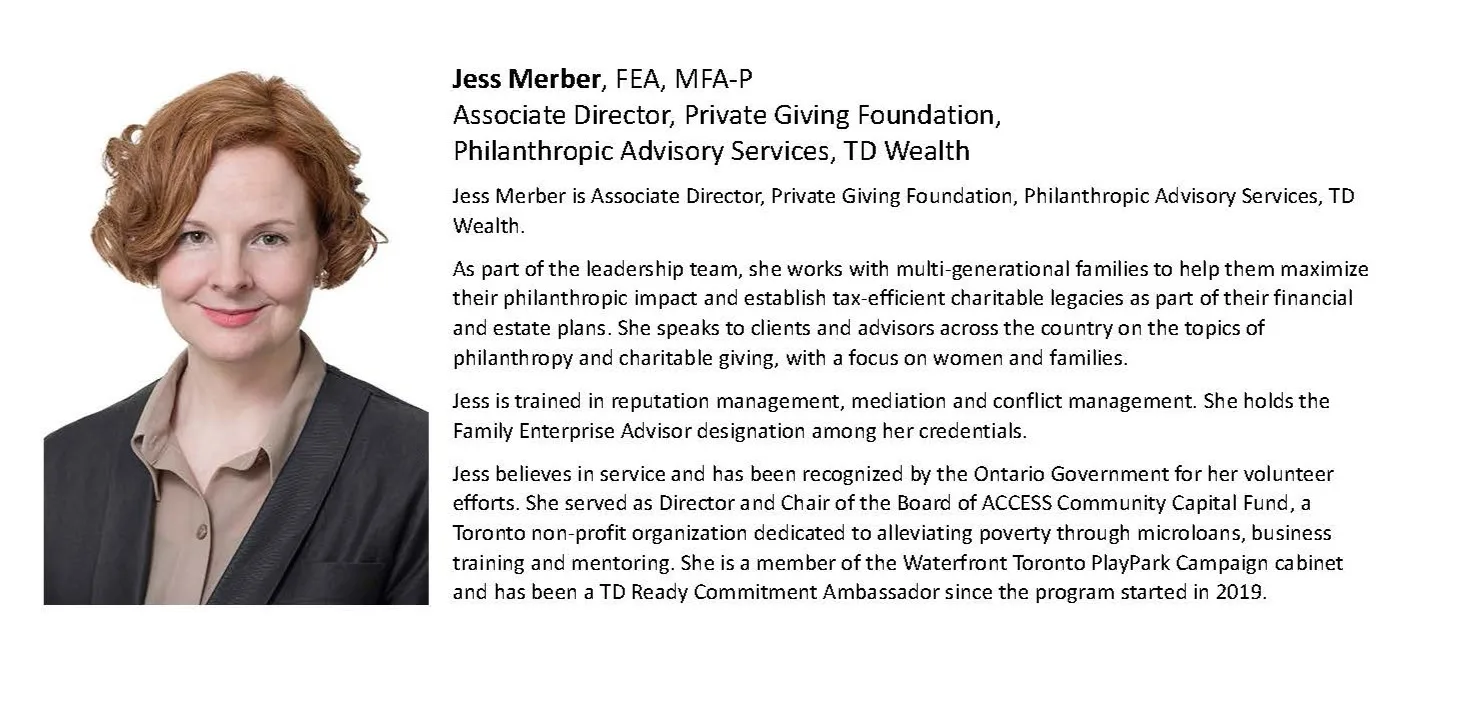

We connected with Jess Merber, Associate Director, Private Giving Foundation, Philanthropic Advisory Services at TD Wealth to get some insights and tax tips for you when making the first step in developing your personal charitable giving plan and making the most of your gift.
When incorporating charitable giving as part of your financial and estate plan, consider these points:
- Donate publicly traded securities. It is always better to donate appreciated publicly traded securities instead of cash. You will receive a donation receipt for the market value, and you will eliminate the capital gains tax. If you still want to own the security, you may repurchase it with other money immediately, and the adjusted cost base will reflect the new market value.
- Consider a planned gift. Leave a bequest in your will or consider maximizing your legacy with the purchase of life insurance. Depending on how it is structured, you may receive a donation receipt for the annual premiums. If you have an insurance policy that is no longer required to fulfill your estate, business, or other needs, you may want to consider donating it to a registered charity. You will receive a tax receipt for the appraised value of the policy.
- Consider a donor-advised fund. Donor-advised funds (DAFs) are the fastest growing charitable vehicle in Canada. A donation receipt is issued upfront, while establishing a long-term legacy of giving. A DAF allows you to donate now and decide later. It is a simple alternative to establishing a private foundation. Private Giving Foundation is a DAF and can be established for as little as $10K.
Canada has some of the most generous tax incentives when it comes to charitable giving. While the tax receipt isn’t the number one reason Canadians give, it’s important to understand how to give in the most tax-efficient manner so that you can maximize the impact of your gift.